Share |
Showing posts with label News. Show all posts

Sunday, March 20, 2011

US, Allies Attack Libya

 
Photo: AP/U.S. Navy, Fireman Roderick Eubanks
This Saturday, March 19, 2011 photo provided by the U.S. Navy shows the guided-missile destroyer USS Barry (DDG 52) as it launches a Tomahawk missile in support of Operation Odyssey Dawn from the Mediterranean Sea .

U.S.-led coalition forces have launched more than 100 Tomahawk missiles on key air defense sites across Libya as part of operations to protect the population from the forces of long-time leader Moammar Gadhafi.

U.S. Vice Admiral William Gortney outlined what is being called "Operation Odyssey Dawn" several hours after he said the missiles started hitting more than 20 Libyan sites.

"The United States military has and will continue to use our unique capabilities to create the conditions from which we and our partners can best enforce the full measure of the U.N. mandate.  Our mission right now is to shape the battle space in such a way that our partners may take the lead in execution," he said.

He said Admiral Sam Locklear was leading the operations from the USS Mount Whitney in the Mediterranean Sea.

A U.N. Security Council resolution was approved Thursday in New York allowing outside forces to use all measures necessary to protect civilians in Libya, where eastern rebel-controlled areas have been under attack.

Admiral Gortney said one British submarine was used as part of Saturday’s strikes as well as U.S. ships and submarines. He described Libya’s air defense sites as being built with old Soviet technology.

He said some countries who were taking part in the military operation had asked to be identified, while others wanted to announce their involvement themselves.

"Of the coalition, the countries that have asked us to mention their names, of course, the United States, UK, French, Italy and Canada.  The other countries have asked for them, that they want to be able to make the announcement and it is the same for the Arab countries as well," he said.

A mediation delegation from the African Union was due in the capital Tripoli Sunday, but as sites in and around Tripoli were also reported hit, it was unclear if that mission would go ahead.

Earlier Saturday, French fighter planes which had departed from France flew over Libya bombing at least one tank that a senior French military official identified as belonging to forces loyal to Mr. Gadhafi.

Leaders from France, Britain and the United States have said the operations are necessary and that Mr. Gadhafi’s forces were still staging attacks despite warnings to stop.

Libya’s head of parliament, Abdul Qasim al-Zuai denied this, saying a ceasefire was in place and that the missile strikes were what he called a "barbaric aggression" from Western powers. He said civilian areas and civilian infrastructure were being targeted.

Earlier in the day, Mr. Gadhafi wrote a letter to President Obama and other world leaders saying they would regret what he called "intervention in the internal affairs of Libya."

Libyan state media said the strikes caused casualties in Tripoli.

At a summit earlier Saturday in Paris, French President Nicolas Sarkozy said Libyans like other Arabs were fighting for democracy and freedom from oppressive regimes and that it was the duty of outside powers to help them.

The British Prime Minister David Cameron said British forces were helping end what he called "the appalling brutality" of Mr. Gadhafi’s government.

Several countries have spoken out against the operations including Russia and Venezuela. Venezuela’s President Hugo Chavez said it was irresponsible to create more deaths and more war.

The International Committee of the Red Cross called on all warring parties to spare civilians and respect international humanitarian law.

The armed rebellion against Mr. Gadhafi began last month, following people power movements which successfully toppled long-time leaders in Egypt and Tunisia and spurred uprisings across north Africa and the Middle East.

Thursday, March 17, 2011

Helicopters Douse Quake-Damaged Nuclear Plant with Water

 
Photo: AFP - NHK
This screengrab taken off Japanese national broadcaster NHK shows a Japanese military twin-rotor cargo helicopter dumping water onto reactor no. 3 at the stricken Fukushima nuclear power plant on March 17, 2011. 

Japanese officials have deployed military helicopters to dump water over the earthquake-damaged Fukushima Daiichi nuclear power plant to try to cool down overheated reactors inside.

The officials are trying to avert a catastrophic radiation leak from spent fuel rods inside the plant's reactors. Japanese television Thursday morning showed helicopters dumping water over the plant from huge buckets.
A top U.S. nuclear official says there is a significant risk of dangerous levels of radiation from the plant, which was damaged last week in a massive earthquake and resulting tsunami. U.S. Nuclear Regulatory Commission Chairman Gregory Jaczko told lawmakers in Washington Wednesday that cooling systems inside the plant have failed, making it very difficult to keep the fuel rods cool.

This screengrab taken off Japanese national broadcaster NHK shows a Japanese military twin-rotor cargo helicopter dumping water onto reactor no. 3 at the stricken Fukushima nuclear power plant on March 17, 2011.
Japanese officials have deployed military helicopters to dump water over the earthquake-damaged Fukushima Daiichi nuclear power plant to try to cool down overheated reactors inside.

The officials are trying to avert a catastrophic radiation leak from spent fuel rods inside the plant's reactors. Japanese television Thursday morning showed helicopters dumping water over the plant from huge buckets.


A top U.S. nuclear official says there is a significant risk of dangerous levels of radiation from the plant, which was damaged last week in a massive earthquake and resulting tsunami. U.S. Nuclear Regulatory Commission Chairman Gregory Jaczko told lawmakers in Washington Wednesday that cooling systems inside the plant have failed, making it very difficult to keep the fuel rods cool.
In Vienna, the International Atomic Energy Agency said temperatures in three of the reactors at the Japanese plant have been rising. It called the situation "very serious."
Nuclear fuel rods remain extremely hot for weeks or months, even when they are not in use. Without steady supplies of water to keep the fuel rods cool, their outer casings can melt and release large amounts of radiation into the atmosphere.
At the time of the earthquake, only three reactors were in use at the plant. They were inside thick concrete-and-steel chambers designed to contain radiation, even if molten fuel rods melt down. Explosions have severely damaged the outer buildings of all three of the units.

Elsewhere, the plight of thousands of people left homeless by the earthquake and tsunami has worsened after a cold snap brought snow to the worst-affect areas.  Officials report that supplies of water and heating oil are low at evacuation centers, where many survivors are bundled in blankets.

Tens of thousands of households in northeastern Japan are still without electricity in near-freezing weather. The government says at least 1.5 million households in the area lack running water.

Sunday, February 20, 2011

Republicans Vote to Cut $61 Billion In Government Spending

 
Photo: AP
Congressmen walk down the steps of the House of Representatives as they work throughout the night on a spending bill, on Capitol Hill in Washington, February 18, 2011

Efforts to cut the U.S. federal budget to counter a rising deficit projected at $1.6 trillion this year are now moving to the Democratic Party dominated Senate.
The Republican controlled House of Representatives passed a bill early Saturday with about $60 billion in spending cuts.
During Saturday’s early morning debate House Speaker John Boehner said the next few months will be the most important Washington has seen in decades.
In a vote which ended at four in the morning, lawmakers voted almost entirely along party lines. Most Republicans were in favor of the bill to cut current spending by about 14 percent, while Democrats were in opposition.
The bill is a stop-gap measure known as a continuing resolution. It establishes spending levels for the rest of the fiscal year ending in September.
But Democratic lawmakers in the Senate have promised to remove many of the bill’s cuts.
These include eliminating spending to carry out President Barack Obama’s recently signed health care reform law. The cuts also target federal funding for family planning, the government’s ability to enforce environmental regulations, education programs, subsidies for the poor and foreign aid.
The bill does include increases, such as a nearly two percent rise for defense spending, despite some internal Republican opposition.
During the House debate, California Republican John Campbell was one of those urging deeper defense cuts. "There are many weapons systems funded in the Defense Department which the Defense Department does not want. They are there because of influential members of Congress who have put them in.  Defense has always been the most earmarked section of the entire budget," he said.
Democratic lawmakers, such as Georgia’s Sanford Bishop, warned against cuts that would affect war veterans. “If this bill is signed into law it will hurt our economic recovery which in turn will affect our veterans.  According to the Bureau of Labor Statistics, more than 15 percent of Iraq and Afghanistan war veterans are unemployed, far higher than the national jobless rate. If we follow through with some of these disastrous cuts we will see that rate go higher," he said.
The Senate is expected to spend the next few weeks debating and writing its own version of a government funding bill. Senate Democrats say they also want to begin shrinking the deficit, but not the way House Republicans voted for.
If no compromise is found by March 4, when current funding expires, a U.S. government shutdown becomes a possibility, unless all parties, including Democratic President Obama, can agree on a short-term spending bill.

Sunday, February 13, 2011

Egyptians Celebrate Mubarak Departure, Look to Future

 
Photo: AP
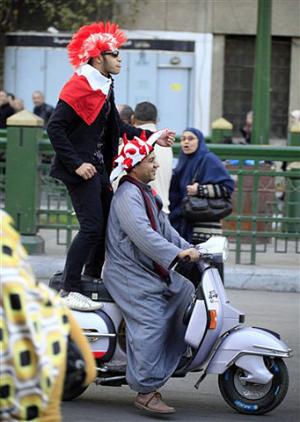
Egyptians celebrate on Tahrir Square in Cairo, February 12, 2011

Egyptians are cleaning up after celebrations that followed the resignation of Hosni Mubarak, Egypt's leader of nearly 30 years. The military, which assumed control of the country,  on Saturday said Mr. Mubarak's Cabinet will remain in place for now while Egypt transitions to a democratic system. The military also vowed to "remain committed to all regional and international" accords including peace treaties, confirming Egypt's landmark 1979 peace treaty with Israel would remain intact.

Saturday was a day of cleaning at Tahrir Square and throughout Central Cairo even as celebrations were going on.  Groups of people went to the streets and to the square with brooms and dustpans in hand to help clear up the filth and debris that built up during the 18 days of demonstrations. 

Some wore banners on their clothing that said “yesterday I was a demonstrator, today I am building Egypt.”

24-year-old architect Rania Tamoum says it was important for her to show she wants to be a part of the rebuilding process.  “It's our country. It's our responsibility, so we have to clean it,” she said.

Tamoum joined thousands of others in celebrating Hosni Mubarak's resignation.   She said she has not thought about a blueprint for the future, since her only goal while demonstrating was to see Mr. Mubarak go.

“Actually, I cannot say what clearly I want.  I can say that I want a better Egypt. I really want a new government.  We don't want any of the icons or the symbols of the old government,” said Tamoum.

The mood was jovial Saturday, even as celebrations were winding down.  A group of men sang an Islamic song, as they walked off the square. Some people began taking down the tents where they have been camping out, and preparing to go home.  Some are staying.

Abdel Hamed Taha, an imam, said Mr. Mubarak's departure was only the beginning of the changes he wants to see.  He will remain on the square.

He says he is at the square to follow up on what he says was the victory of the revolution.  He said demonstrators have achieved only one of the demands, and he wants a dialogue with the army.


News RSS Feeds RSS Feed

Egyptians Celebrate Mubarak Departure, Look to Future

Egyptians celebrate on Tahrir Square in Cairo, February 12, 2011
Photo: AP
Egyptians celebrate on Tahrir Square in Cairo, February 12, 2011

Share This

Related Articles

Egyptians are cleaning up after celebrations that followed the resignation of Hosni Mubarak, Egypt's leader of nearly 30 years. The military, which assumed control of the country,  on Saturday said Mr. Mubarak's Cabinet will remain in place for now while Egypt transitions to a democratic system. The military also vowed to "remain committed to all regional and international" accords including peace treaties, confirming Egypt's landmark 1979 peace treaty with Israel would remain intact.

Saturday was a day of cleaning at Tahrir Square and throughout Central Cairo even as celebrations were going on.  Groups of people went to the streets and to the square with brooms and dustpans in hand to help clear up the filth and debris that built up during the 18 days of demonstrations. 

Some wore banners on their clothing that said “yesterday I was a demonstrator, today I am building Egypt.”

24-year-old architect Rania Tamoum says it was important for her to show she wants to be a part of the rebuilding process.  “It's our country. It's our responsibility, so we have to clean it,” she said.

Tamoum joined thousands of others in celebrating Hosni Mubarak's resignation.   She said she has not thought about a blueprint for the future, since her only goal while demonstrating was to see Mr. Mubarak go.

“Actually, I cannot say what clearly I want.  I can say that I want a better Egypt. I really want a new government.  We don't want any of the icons or the symbols of the old government,” said Tamoum.

The mood was jovial Saturday, even as celebrations were winding down.  A group of men sang an Islamic song, as they walked off the square. Some people began taking down the tents where they have been camping out, and preparing to go home.  Some are staying.

Abdel Hamed Taha, an imam, said Mr. Mubarak's departure was only the beginning of the changes he wants to see.  He will remain on the square.

He says he is at the square to follow up on what he says was the victory of the revolution.  He said demonstrators have achieved only one of the demands, and he wants a dialogue with the army.

The transition is now in the hands of the military, which has promised to hand over power to an elected civilian government. The demonstrators demanded  free and transparent elections in which all groups - including the banned Islamist Muslim Brotherhood can participate.  They also want a lifting of emergency laws, and a re-writing of the constitution.

A spokesman for Egypt's supreme council of the armed forces on Saturday said it has asked the existing Cabinet to stay in a caretaker capacity. He also said Egypt will respect its existing international agreements that include a peace treaty with Israel.

Over the past few days, the army has emerged as heroic in the eyes of many Egyptians for not cracking down on the demonstrators.  On Saturday, tanks stayed in their positions throughout central Cairo. People took pictures with soldiers, and children handed them flowers.

Now, Egyptians are counting on the military to take the country to the next step, and deliver on the promises of a change for the better.

Thursday, February 10, 2011

Protests, Strikes Spread as Egypt's Regime Stiffens

 
Photo: AP
An anti-government protester wakes up after spending the night in front of the main gate of the Egyptian Parliament in Cairo, February 10, 2011

Thousands of anti-government protesters remain in Cairo's Tahrir Square and outside Egypt's parliament building Thursday as they continue their campaign to oust embattled President Hosni Mubarak.

In addition to the prolonged protests in the capital, the opposition has turned to labor actions across Egypt affecting tourism, textiles, railways and the government.

The protesters are seeking to pressure Mr. Mubarak, who has been in power for 30 years, while also demanding the resignation of lawmakers elected late last year in a vote widely condemned as rigged in favor of the ruling party.

Egyptian Vice President Omar Suleiman has said the government will not tolerate prolonged anti-government protests in Tahrir Square. He warned activists not to attempt more civil disobedience, calling it "extremely dangerous."

Protest organizers said they are working on plans to move to the state radio and television building Friday, when another mass demonstration has been called.

On Wednesday, more than 6,000 disaffected workes demonstrated against low wages and poor conditions at five companies owned by the Suez Canal Authority, which is a major component of the Egyptian economy.  Two thousand textile workers demonstrated in Suez, while thousands hurt by the collapse of the tourism industry held protests in Luxor.

Hundreds of slum dwellers in the Suez Canal town of Port Said set fire to parts of the governor's headquarters, angry over the lack of housing.

Anti-Mubarak protests resulting in several deaths also erupted in the desert oasis of Kharga, 600 kilometers south of Cairo, as demonstrators burned police stations and other government buildings.

Thousands of government workers from the health and telecommunications offices protested in several locations across Cairo Wednesday. Many were contractors, demanding full-time work and benefits.

Meanwhile, the nation's largest circulation newspaper, the iconic al-Ahram, began to shift from its pro-government reporting.  On Wednesday, the front page, which had sought for days to downplay the protests, called recent attacks by pro-Mubarak supporters on Tahrir Square an "offense to the whole nation."

Protesters have turned the square into a sprawling tent city, complete with medical facilities, charging stations for mobile phones, sound stages and a radio station.

A committee of judges and legal scholars appointed by Mr. Mubarak agreed Wednesday to propose six constitutional amendments and said further articles could also be changed.

But Egypt's banned Muslim Brotherhood, which broke ranks with the opposition to meet with Mr. Suleiman, rejected what it said were half-measures by the regime.

Some information for this report was provided by AP, AFP and Reuters.

Egyptian Protesters, Government Dig In

 
Photo: VOA - J. Sokolovsky
Protesters in Tahir Square, Cairo, 8 February 2011

A steady flow of protesters converged on Cairo's Tahrir Square again Wednesday, while some spread to new areas, with new supporters joining the demonstrations.  Continuing government concessions seem not enough to bring the opposing sides any closer.

New positions

Some demonstrators have moved out from Tahrir Square, taking up positions in front of Egypt's parliament.  They vow not to stand down until President Hosni Mubarak and the government do the same.

New groups are taking up the anti-government banner. Factory and government workers are making an appearance, demanding higher wages.  And some unions are joining in, with workers striking in other parts of the country, from Helwan, south of Cairo, to Suez.

Key demands

The political protesters' key points remain the same: an overhaul of the government system, with real constitutional change and an end to the emergency law, which has allowed for arbitrary arrest, detention and alleged torture for nearly 30 years.

Mohamed Ismail, a doctor who has been helping tend to the protesters, says he has no trust in the government's concessions so far.

Ismail does not believe the constitution will be reformed as promised, because the current parliament, he says, is a fraud. He adds the government will not lift the emergency law because of the new excuse of the protests.

The doctor says the two sides are deadlocked.

Not that Egypt's government is oblivious to the demonstrations, now in their third week, and authorities say, costing the country more than $300 million a day.

Government response

State media announced Wednesday that authorities have released 34 political prisoners.  Among them are members of the banned Muslim Brotherhood, whose leadership is engaged in unprecedented dialogue with the government.

But as for the core demand, Vice President Omar Suleiman said again late Tuesday that President Mubarak is not going to step down. Suleiman warned that the only alternative to the dialogue underway is a coup.

But as the government digs in, so too, do the protesters.

Another doctor on the square dismisses the argument that if Mr. Mubarak leaves, chaos would ensue.

Kamal Abu Sena urges the president to live with dignity and "abdicate," as he put it.  There will be no chaos, he says, adding, suppose Mr. Mubarak dies in the morning?  He argues there are laws and institutions and "lots of honest people" who can protect the country.

Slideshow of photos from Tahrir Square

White House Presses Egyptian Leaders For More Change

 
Photo: AP
White House Press Secretary Robert Gibbs briefs reporters about the situation in Egypt (file photo)

 U.S. officials say Egypt’s leaders are not making a minimum amount of reforms their people demand.  The Obama administration continues to push President Hosni Mubarak’s government for greater change. 

President Barack Obama’s spokesman, Robert Gibbs, told reporters Wednesday the demonstrations in the streets of Cairo will continue to grow until Egypt’s government makes adequate reforms.

"I think it is clear that what the government has thus far put forward has yet to meet a minimum threshold for the people of Egypt," said Gibbs. "That is why many of you reported that the crowds in yesterday’s [Tuesday] protests were bigger than even those on Friday."

Gibbs says the United States is calling on President Mubarak to begin an orderly transition immediately, and allow his people to have basic civil and political rights.

"Unless or until that process takes hold, I think you are going to see the continued pictures that all of us are watching out of Cairo and other cities throughout Egypt," he said.

Administration officials say they have been in contact with not only members of Mr. Mubarak’s government, but also leaders of Egypt’s civil society.

One of the more recent high-level contacts was a telephone call Tuesday between Vice President Joe Biden and his Egyptian counterpart, Omar Suleiman.

Vice President Suleiman’s efforts to talk with protesters about proposed reforms have broken down in recent days.  He warned Tuesday that what he called a "coup" could take place unless demonstrators agree to negotiate.

Gibbs told reporters Wednesday the Egyptian people’s concerns cannot be met by violence, and that immediate and irreversible change is needed.  He also said the situation will not be resolved if the government is not willing to change and the protesters are not willing to negotiate.

Since the demonstrations began about two weeks ago, Mr. Mubarak has said he will not seek re-election in September.  Also, Vice President Suleiman announced that the president’s son, Gamal Mubarak, would not be a candidate for national office.  And the leadership of the president’s National Democratic Party stepped down.

However, U.S. officials say Egypt’s leaders need to listen to the demonstrators in the streets and implement wider reforms.

Wednesday, February 9, 2011

US: Egypt Must End Emergency Law, Broaden Talks

 
Photo: AP
Egyptian anti-Mubarak protesters shout slogans as they march in Alexandria, Egypt, Feb 8, 2011

The United States says the Egyptian government must do more to address the demands of opposition groups. It is calling for Cairo to immediately repeal an emergency law allowing detention without charge, and to allow greater participation in transition talks.

The White House says Vice President Joe Biden spoke to his counterpart in Egypt Tuesday to emphasize that the Egyptian government must stop beating, harassing and detaining protesters and those reporting on the massive demonstrations.

Biden also told Omar Suleiman that Egypt should broaden the range of opposition groups included in developing a plan for transitioning the government, and immediately rescind the country's deeply unpopular emergency law, in place since Mr. Mubarak took office in 1981.

In New York Tuesday, U.N. chief Ban Ki-moon said the Egyptian people are frustrated and demanding "bold reforms" that should be implemented quickly - "the sooner the better." He said all parties must avoid violence and he repeated his call for an "orderly and peaceful transition."

Mr. Ban said Egypt and its president, Hosni Mubarak, are key players in the Middle East peace process, and that he hoped Cairo will continue to play an important stabilizing role in a volatile region.

Earlier, in his first public comments on the unrest, U.S. Defense Secretary Robert Gates praised the Egyptian military for its restraint, reiterated the need for an orderly and steady transition, and prodded other Arab governments in the region to reform.

Gates said the pro-democracy demonstrations in Egypt and Tunisia should inspire other Middle Eastern governments to begin moving in a "positive direction" toward addressing the political and economic grievances of their people.

U.S. President Barack Obama has called for a transition in Egypt that engages all parties and leads to democratic practices, free and fair elections, and a representative government that is responsive to the grievances of the people.

U.S. government figures indicate the State Department and U.S. Agency for International Development (USAID) provided $1.5 billion in assistance to Egypt last year, mostly for security. The budget request for 2011 is about the same.  U.S. officials say there are no plans to cut off the aid, but caution the assistance will be reviewed as events unfold.

Mr. Mubarak, who has been president for nearly three decades, has responded to the protests by declaring that he will not run for a sixth term in a September election.

Tuesday, February 8, 2011

Despite Talks in Egypt, Protests Continue

 
Photo: AP
Anti-government demonstrators gather in Tahrir Square, the center of anti-Mubarak protests, in downtown Cairo, Egypt, February 7, 2011

Talks between Egypt's opposition and the government of President Hosni Mubarak have failed to stop thousands from demonstrating and calling for his immediate removal.
The Egyptian capital appeared to be desperate to get back to a normal routine. Traffic was snarled during commute times, with drivers sometimes having to go around army tanks and burned out vehicles - reminders of violent demonstrations.

Banks opened for a second day, but there was still no trading on the stock exchange.
Just as some people want things to return to normal, the demonstrators want to ensure that pressure is sustained on Mr. Mubarak to go, and that their efforts do not fade away.

On day 14, they continued to stream into Tahrir Square.

The opposition, like the protesters, says it is not satisfied with the outcome of talks between opposition groups and Mr. Mubarak's government. Those groups include the Muslim Brotherhood, which has been banned for decades.

One of the key leaders of the Muslim Brotherhood group told VOA dialogue can continue only if the government responds to the opposition's demands for deep political reform.

Earlier, another group spokesman, Isaam Eryan, met with reporters.  He said no sane person or politician can reject dialogue, but he said this dialogue must be serious, representative and productive.

The Muslim Brotherhood is one the main backers of the demonstrations.

Pressure during the past 14 days has forced Mr. Mubarak to make concessions. He has named a Vice President, announced he will not seek reelection this year, and his party has seen the resignation of its top leaders. 

But Egypt's opposition has failed to come up with a united front, and it is divided on how the transition of power should occur.

Some, including the protesters at Tahrir Square, want Mr. Mubarak to depart immediately, and some want him to leave the country or be put on trial. Others want him to stay and say they are grateful for the political stability his government has maintained over three decades, as well as for government entitlements that some have received during his tenure.

A third group includes many of those in the Egyptian capital who went back to work this week hoping for democratic change, but who say they want it in an orderly way that will soon return this country to normal.

Obama Courts US Business Leaders

 
Photo: White House - C. Kennedy
President Obama record his weekly address for February 5, 2011

President Barack Obama is continuing his efforts to reach out to some of his sharpest critics in the U.S. business community. The president is hoping to ease some business leaders’ opposition to his economic plan and his re-election bid.

America’s top business leaders, many of whom are Republicans, have been skeptical about President Obama’s economic policies from the start.

One of the most consistent critics has been the U.S. Chamber of Commerce, which is based two blocks from the White House.  The Chamber represents more than three million businesses, and calls itself the world’s largest business federation.

Lately, the president has been trying hard to win over the Chamber and other business leaders to his proposals to make American companies more competitive globally.

His next step in that effort will be a speech at Chamber of Commerce headquarters on Monday.  Administration officials hope the visit will mark a turning point in the president’s relationship with corporate America.

In his weekly address Saturday, Mr. Obama said he will tell the corporate leaders that government has certain responsibilities to help promote American businesses.  Among those responsibilities, he says, are providing the world’s best schools, the best infrastructure and the best incentives to innovate.

He said he will also tell the executives that they have responsibilities as well. “If we make America the best place to do business, businesses should make their mark here in America.  They should set up shop here and hire our workers and pay decent wages and invest in the future of this nation.  That is their obligation," he said.

Mr. Obama’s outreach to business has gained momentum since he and Republicans in Congress reached a compromise in December to extend the life of tax cuts begun during George W. Bush’s presidency.

Another move seen as pro-business was the appointment of William Daley as White House Chief of Staff.  Daley had served as Commerce Secretary during Bill Clinton’s administration, and since held a high-ranking position at the large bank JP Morgan Chase.

President Obama has harshly criticized Wall Street bankers in the past for accepting big salary bonuses while their firms received government bailouts.  The Chamber of Commerce, meanwhile, made large contributions to Republican candidates in last November’s midterm elections, in which numerous Democrats were swept out of office.

Meanwhile, some liberal Democrats are furious about the president’s pro-business turn, saying he has abandoned their party’s principle of fighting for the well-being of workers.

Mr. Obama is trying to strike a balance on the issue, talking with workers at factories that produce equipment for alternative energy, and also hosting a day-long summit for executives of the nation’s largest companies.